
Sure, listening to VHF FM has great advantages over MW/LW AM from the old days — now we have bright stereo free from interference, fading and noise! However, your FM radio will no longer predict the arrival of a thunderstorm as did the AM radio many years ago — reliably and hours before the trouble was upon you! The crux is that AM detection will faithfully reproduce the effects of lightning and other massive static discharges approaching in a very simple way: they’re audible as slight crackling noises in the loudspeaker, almost irrespective of the tuning of the radio!
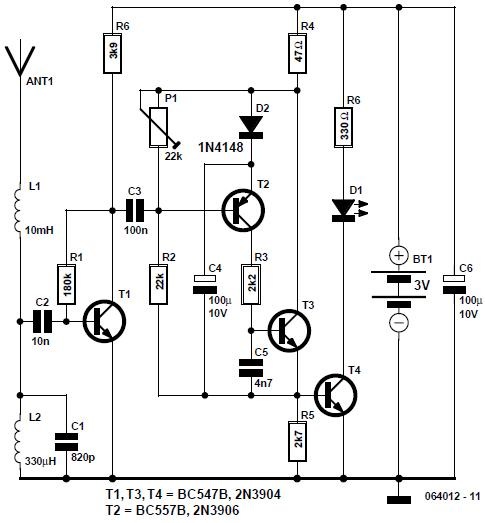
Assuming no AM radio is available anymore, a dedicated VLF receiver tuned to about 300 kHz can faithfully detect the crackle of approaching lightning. The simple receiver shown here consists of a loosely tuned amplifier driving a kind of flasher circuit that blinks an LED in synchronicity with the lightning bolts. The frequency and intensity of the LED activity indicates the intensity and distance of the storm respectively.
Looking at the circuit diagram, the LED driver is not biased to flash until a burst of RF energy, amplified by T1, arrives at the base of T2. The receiver works off 3 volts and has a negligible standby current of about 350 microamperes which will hardly dent the shelf life of a couple of 1.5-V D-size cells.
T2 and T3 form a monostable generator triggered by sudden drops in T1’s collector voltage. Preset P1 is adjusted until the LED remains off when you’re sure there’s no thunderstorm around for a few hundred miles. The value of the LED series resistor is subject to experimentation and LED current.

Author: Karel Walraven
(Elektor Electronics Magazine – 2006)
 | * Download this article. |
ICs that in the past were far too expensive for the hobbyist tend to be more favorably priced these days. An example of this is the AD8099 from Analog Devices. This opamp is available for only a few pounds. The AD8099 is a very fast opamp (1600 V/ms) and has high-impedance inputs with low input capacitance.
The bandwidth of the opamp is so large that at 100 MHz it still has a gain of nearly 40. This means that this opamp can be used to create an RC oscillator. The circuit presented here realises that.
The circuit has a few striking characteristics. Firstly, unlike normal oscillators that contain transistors this one does not have any inductors. Secondly, there is no need for a varicap diode to do the FM modulation.
The opamp is configured as a Schmitt trigger with only a small amount of hysteresis. The output is fed back via an RC circuit. In this way, the trimmer capacitor is continually being charged and discharged when the voltage reaches the hysteresis threshold. The output continually toggles as a consequence. This results in a square wave output voltage. With a 10-pF trimmer capacitor the frequency can be adjusted into the VHF FM broadcast band 88-108 MHz). The frequency of the oscillator is stable enough for this. The output voltage is about 6 Vpp at a power supply voltage of 9 V. The transmitter power amounts to about 50 mW at a load of 50 Ω. This is about 20 times as much as the average oscillator with a transistor.
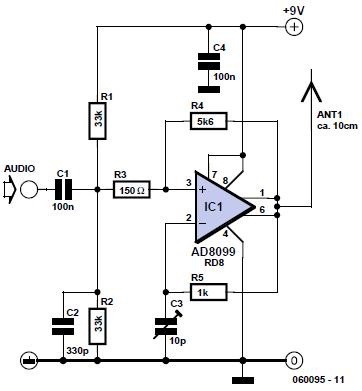
The FM modulation is achieved by modulating the hysteresis, which influences the oscillator frequency. An audio signal of about 20 mVpp is sufficient for a reasonable output amplitude.
The package for the opamp is an 8-pin SOIC (provided you use the version with the RD8 suffix). The distance between the pins on this package is 1/20 inch (1.27 mm). This is still quite easy to solder with descent tools. If SMD parts are used for the other components as well then the circuit can be made very small. If necessary, a single transistor can be added to the circuit to act as microphone amplifier. The power supply voltage may not be higher than 12 V, because the IC cannot withstand that. The current consumption at 9 V is only 15 mA.
As with all free-running oscillator circuits, the output frequency of this specimen is also sensitive to variations of the power supply voltage. For optimum stability, a power supply voltage regulator is essential.
As an additional design tip for this circuit, we show an application as VCO for, for example, a
PLL circuit. When the trimmer capacitor is replaced with a varicap diode, the frequency range can be greater than that of an LC oscillator. That’s because with an LC-oscillator the range is proportional to the square root of the capacitance ratio. With an RC oscillator the range is equal to the entire capacitance ratio. For example: with a capacitance ratio of 1:9, an LC oscillator can be tuned over a range of 1:3. With an RC oscillator this is 1:9. For the second tip, we note that the circuit can provide sufficient power to drive a diode mixer (such as a SBL-1) directly. This type of mixer requires a local oscillator signal with a power from 5 to 10 mW and as already noted, this oscillator can deliver 50 mW. A simple attenuator with a couple of resistors is sufficient in this case to adapt the two to each other.
Author: Gert Baars
(Elektor Electronics Magazine – /2006)

- Download this article.
